In This Article
SHARE



Do You Have An Interesting Project?
Introduction
I have been building software for over twenty years. I have managed development teams, led technical architecture, and watched the industry go through several cycles of tools and frameworks that were supposed to change everything.
Most of them changed something. None of them changed everything.
AI agents changed everything.
I want to write about what that actually looked like inside icodelabs — not the polished version, but the real one. The reluctance, the experiments that failed, the moment things clicked, and what our team looks like now compared to three years ago.
2024: Experimentation and Resistance
We started experimenting with AI tools in early 2024. Bolt and Replit were the first tools we tried seriously as a team.
The results were genuinely interesting for the right use cases. Single-page applications, admin panels, internal dashboards — these came together quickly and the output was usable. We could see the potential immediately.
But when we tried to apply the same tools to Sharetribe marketplace projects — which is the majority of what icodelabs builds — we struggled. The complexity of the Sharetribe template, the transaction logic, the integration requirements — these pushed against the limits of what those tools could handle reliably at the time. The output was inconsistent. More time was spent correcting AI-generated code than writing it manually would have taken.
The team reaction was mixed, which I expected but still had to manage carefully.
Some developers were genuinely resistant. Not hostile — but reluctant. The concern was not really about job security, though that was in the background. It was something more personal: the fear that skills built over years of hard work were being devalued. A developer who spent five years becoming deeply proficient in React, who takes pride in clean code and thoughtful architecture, does not immediately welcome a tool that appears to make their proficiency less relevant.
Other developers were the opposite — excited to experiment, curious about the possibilities, willing to try things that did not work. These were not necessarily the most senior developers. Sometimes the most experienced were the most protective of their existing methods.
What I observed in 2024 was that the tool itself was not yet ready for our most complex work, and the team was not yet ready to fully trust it. Both things needed to change.
2025: The Shift Becomes Real
2025 was the year it stopped being an experiment and started being how we worked.
Cursor and Windsurf became embedded in daily development across the team. The tools had matured, the developers had learned how to direct them effectively, and the results were consistent enough to trust on real client projects.
By mid-2025, 70–80% of code being written on icodelabs projects was being written through AI agents. Not generated blindly — directed by developers who understood what they needed, reviewed critically, and corrected where necessary. But the ratio of human keystrokes to AI-generated code had inverted from where we started.
Something interesting happened to the team dynamic during this period. The developers who had been most resistant in 2024 began to come around — not because they were told to, but because they saw what their colleagues were achieving. When a developer who embraced Cursor was delivering features in a day that previously took three, and the quality was holding up under review, the argument against the tools became harder to sustain.
The developers who adapted fastest were not always the ones I expected. Seniority was not the determining factor. What mattered was the willingness to rethink the workflow — to approach a feature by first having a conversation with an AI agent rather than immediately opening a file and starting to type. That shift in instinct, from coder to director, was the real learning curve.
The ones who struggled longest were the ones who used AI agents as a faster way to do what they had always done, rather than as a fundamentally different way of working. Asking an AI agent to complete a function you have already started is useful but limited. Asking an AI agent to think through a problem with you before you write a single line of code — that is where the real leverage is.
2026: Claude Code and the Inflection Point
Claude Code changed things in a way that Cursor and Windsurf, as good as they are, had not.
The difference is hard to articulate precisely, but I will try. Cursor and Windsurf made developers faster at the work they were already doing. Claude Code changed what a single developer is capable of doing alone.
I know this because I experienced it directly.
In early 2026, I built icodelabs' internal project management system using Claude Code. Not with a team — by myself, directing Claude Code through the build over several days. The system replaced our Zoho Sprints subscription entirely. It has GitHub multi-repository integration, a client portal, AI performance tracking, complexity tier modelling for developer output, and automated deployment workflows. It is live and the entire icodelabs team uses it daily.
Two years earlier, building this system would have required a team of three developers working for two to three months. I built it in days.
Shortly after, we took on a project to build a community platform — a replacement for a Circle.so implementation a client was running. Our internal estimate for this project, using traditional development, would have been eight weeks with a team. We delivered it in two weeks with Claude Code embedded throughout the build.
A third project — a client platform I cannot name for confidentiality reasons — followed the same pattern. What the client had budgeted for as a multi-month engagement was delivered in a fraction of the time.
I am not sharing these numbers to boast. I am sharing them because they represent something real that I needed to see with my own eyes before I fully understood what had changed.
What Actually Changed: The Developer as a Complete Unit
When I think about how icodelabs operated in 2021 and 2022, I remember the coordination overhead.
If a developer needed to explore a technical approach to a new feature, they needed research time — sometimes their own, sometimes a conversation with a more senior developer. If a feature needed to be visualised before implementation, a designer needed to be involved. If something needed to be tested, QA needed to be scheduled. If documentation needed to be written, that was either the developer's least favourite task done badly under time pressure, or someone else's job done slowly.
Every step involved a handoff. Every handoff involved waiting. And I, as the person overseeing delivery, was often the person who sat with developers to brainstorm architecture, helped think through complex logic, and made connections between what one part of the team was building and what another part needed.
That coordination model is largely gone.
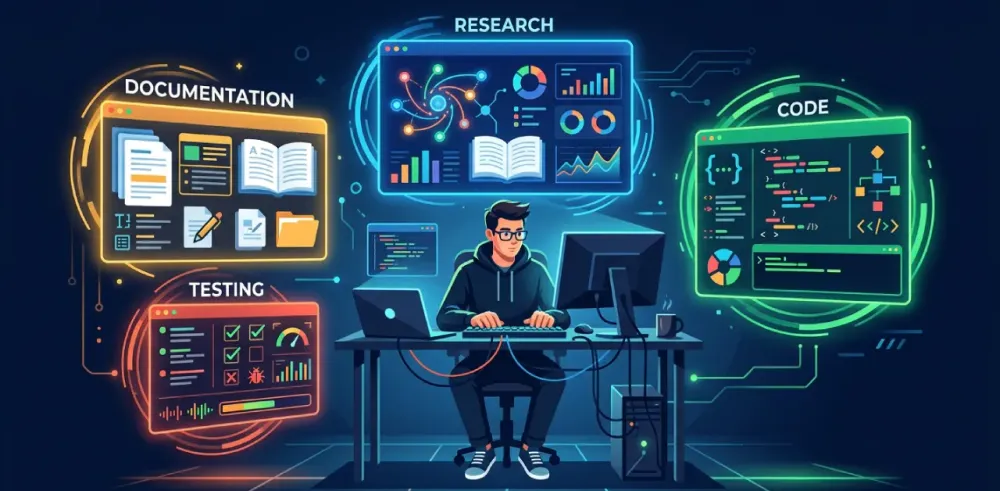
Today, a developer at icodelabs works as a genuinely independent unit in a way that would have been impossible three years ago. When they encounter a technical problem, they research it with Claude. When they need to visualise a feature before building it, Claude generates an interactive artifact. When they need to document what they built, Claude produces a first draft from the code. When they need to test it, Playwright tests are generated through the agent and refined.
The part that surprised me most — and I genuinely did not anticipate this — is what happened to communication and documentation quality across the team. Several of our developers are not native English speakers. Hindi is their first language. Previously, technical documentation from these developers was functional but limited — enough to communicate internally, not enough to send to a client or use as a formal handover document.
Today, those same developers produce technical documentation, implementation guides, and client-facing reports that are clear, structured, and professional. Not because their English improved dramatically in two years. Because AI agents handle the language layer while the developer handles the technical substance. The knowledge was always there. The barrier was expression. That barrier is largely gone.
What Did Not Change
I want to be honest about this because I think it matters.
AI agents did not make architectural judgment automatic. The decisions that determine whether a marketplace can scale, whether a transaction flow will handle edge cases reliably, whether a codebase will be maintainable in eighteen months — these are still entirely human. An AI agent executes within the vision a developer provides. It does not create the vision.
The developers who produce the best results with AI agents at icodelabs are the ones with the strongest underlying engineering judgment. The agents amplified their capability. They did not redistribute capability from experienced to inexperienced developers in the way some predicted.
What did change is where experienced developers spend their time. Less on typing. More on thinking. Less on boilerplate. More on architecture. Less on the parts of the job that were always mechanical. More on the parts that were always interesting.
The ratio of interesting work to mechanical work in a developer's day shifted dramatically. I believe this is why most of the initial reluctance faded — not because the fear was irrational, but because the experience of using the tools well turned out to be more engaging, not less.
What the Team Looks Like Now
icodelabs in 2026 is a different kind of agency than icodelabs in 2022, even though many of the same people are here.
The team is smaller in some roles than it would need to be without AI agents, and the output per developer is significantly higher. Developers who previously needed close oversight for complex features now work independently on problems that would have required senior involvement two years ago.
The profile of a strong icodelabs developer in 2026 is someone who thinks architecturally, specifies precisely, reviews critically, and adapts quickly when the AI output is not what the problem requires. The ability to type fast was never the most valuable developer skill, but it is now actively irrelevant.
What I spend my time on has changed too. Less time sitting with developers to work through technical problems — because they can work through them with AI agents more effectively than a brainstorming session with me. More time on client relationships, strategic decisions, and the business problems that have no AI agent to help with.
Where This Goes Next
I think about this often and I do not have certain answers — only observations.
The cost of building software will continue to fall. What icodelabs can build in six weeks today would have taken six months in 2021. That compression will continue. The founders who will thrive are the ones who use that compression to validate faster and iterate more — not the ones who use it to skip the thinking.
The developers who will thrive are the ones who treat AI agents as a partner in thinking, not a replacement for it. The ability to direct an intelligent system precisely — to give it the context it needs to do useful work — is a skill that will compound over time. The developers building that skill now will be significantly more capable in three years than the ones who are not.
And agencies that built genuine AI-augmented workflows — not claimed it in their pitch but actually restructured how they build — will deliver value that agencies using traditional methods cannot match on timeline or cost.
We are still in the early part of this shift. The developers at icodelabs who were reluctant in 2024 are, with very few exceptions, the same developers who are now the most enthusiastic about where the tools are going. The skills they feared losing turned out to be the foundation the tools needed to work well.
That is probably the most important thing I have learned in the last two years. AI agents do not replace experience. They reveal it.
Final Thoughts
I started icodelabs to build things that matter for clients who have real problems to solve. The tools have changed dramatically in three years. That purpose has not.
What AI agents gave my team was not a shortcut. It was a removal of the friction between what an experienced developer understands and what they can produce. The understanding was always there. Now the gap between understanding and output is smaller than it has ever been.
If you are a founder evaluating development agencies and wondering whether the AI claim is real or marketing — ask them to walk you through exactly how they work. The answer will tell you everything.
And if you are a developer reading this who is still on the fence about AI agents — I understand the reluctance. I watched it in my own team. What I can tell you is that every developer at icodelabs who went through that reluctance and came out the other side is doing the best work of their career.
Jay Tiwary is the founder and CEO of icodelabs, a Sharetribe Vetted Expert Partner and AI-augmented marketplace development agency. If you are planning a marketplace build, book a free scoping call.
FAQ
Did your developers fear losing their jobs when you introduced AI agents?
Some were concerned initially — that is an honest answer. The fear was less about job loss and more about relevance — whether their hard-earned skills would still matter. What actually happened was the opposite. Developers who embraced AI agents became significantly more capable and more valuable. The ones who engaged most openly with the tools are now the strongest members of the team.
How long did it take for AI agents to become genuinely useful in your workflow?
The experimentation phase in 2024 produced mixed results — useful for simple applications, limited for complex Sharetribe projects. 2025 was when Cursor and Windsurf became genuinely embedded in daily work, with 70–80% of code being written through AI agents. Claude Code in 2026 was the inflection point where the workflow changed fundamentally rather than incrementally.
Can a non-technical founder use AI agents to build software?
Yes — with important caveats. I built a fully functional project management system using Claude Code that replaced our Zoho Sprints subscription entirely. But I have 20+ years of development experience. I understood architecture, I knew what to specify, and I could review the output critically. A non-technical founder using AI agents without that foundation will produce faster but still poor results. The agents amplify capability — they do not create it.
What skills matter most for developers in an AI-augmented team?
The ability to think architecturally — to understand how systems fit together and where decisions made today create problems six months later. The ability to specify precisely — to give an AI agent a clear enough brief that the output is useful rather than generic. Critical review — the ability to read AI-generated code and identify what is wrong or what will not scale. And communication — because better specifications produce better code, developers who can articulate requirements clearly produce dramatically better results than those who cannot.
How do you manage quality when AI agents are writing most of the code?
Every line of code that goes into production is reviewed by a developer who takes responsibility for it. AI agents do not deploy code — developers do. The review process is actually more thorough now because developers spend less time on mechanical work and more time on judgment. We also use Playwright for automated end-to-end testing, which catches regressions before they reach users.
What is the biggest mistake teams make when adopting AI agents?
Treating AI agents as a replacement for thinking rather than an accelerant for it. Teams that give vague briefs to AI agents get vague code back. Teams that skip architectural planning because "the AI will figure it out" accumulate technical debt faster than they ever did before. The discipline required to use AI agents well is actually higher than the discipline required for traditional development — not lower.
Related Blogs