In This Article
SHARE



Do You Have An Interesting Project?
Introduction
Something significant happened to the startup market between 2023 and 2026.
Building software stopped being a barrier.
For decades, the hardest part of starting a tech company was getting something built. Technical co-founders were scarce. Development agencies were expensive. The gap between a founder's idea and a working product was measured in months and tens of thousands of dollars.
Then no-code AI platforms arrived — and that gap collapsed almost overnight.
Lovable, Bolt, Base44, and a dozen others now let a non-technical founder describe what they want and receive a working application in hours. Not a wireframe. Not a mockup. A functional product with a UI, a database, and basic logic — built without writing a line of code.
This changed everything. And it also changed nothing.
What No-Code AI Platforms Got Right
It is worth being genuinely honest about this, because the reflex for development agencies is to dismiss these tools. That reflex is wrong.
Lovable, built on top of Claude and other foundation models, is genuinely impressive for what it does. A founder can describe a product, iterate on the UI in real time, and have something demo-ready in an afternoon. For showing an investor what you are building, testing whether a concept resonates with early users, or validating a design direction before committing to development — it is a legitimate and valuable tool.
Bolt takes a similar approach with a strong focus on full-stack generation. Founders who want a working prototype with a backend, not just a front-end UI, find it compelling.
Base44 has found traction particularly with internal tools and lightweight SaaS applications — dashboards, admin panels, simple workflow tools where the data model is straightforward and the transaction logic is minimal.
These platforms are not toys. They represent a genuine democratisation of software creation, and the founders using them well are getting real value.
The problem is not the tools. The problem is a mismatch between what founders think these tools can do and what they actually can do — particularly for marketplace businesses.
Where No-Code AI Platforms Hit the Wall
No-code AI platforms can genuinely handle a lot. Stripe Connect, basic escrow, seller payouts, standard transaction flows — these are achievable. Founders who have launched simple marketplaces on Lovable or Base44 are not imagining the results. The tools work for what they were designed for.
The wall appears later. And when it appears, it is expensive.
The prompt dependency problem
No-code AI platforms are fundamentally prompt-driven systems. The output is only as good as the input. When a founder starts simple — a basic listing, a straightforward purchase flow — the prompts are clear and the output is good. The platform works.
But marketplaces do not stay simple. Every founder changes their mind. Features get added. Business logic evolves. The commission model changes after talking to early sellers. The booking flow needs an extra step after watching real users struggle. A new user role gets introduced that nobody anticipated at the start.
Each change requires a new prompt. Each new prompt is interpreted against the context of everything the AI has already generated. As the product grows, that context becomes heavier, more contradictory, harder to communicate precisely. Founders who are not experienced with how to prompt effectively — and most are not — start getting inconsistent results. A change to the listing flow breaks something in the checkout. A new filter creates a conflict with existing search logic. The platform is no longer generating coherent responses because the system has no architectural memory — only the current prompt and whatever the AI can infer from the existing codebase.
This is the moment founders describe as "it just stopped working properly." Not a single catastrophic failure. A gradual accumulation of inconsistency that becomes harder and harder to unpick.
The absent foundation problem
A professional developer building a marketplace makes hundreds of small architectural decisions before writing a single feature. How the data models relate to each other. How state is managed across the application. How errors are handled consistently. How the transaction process is structured so it can be extended later without breaking existing flows. How the codebase is organised so a new developer can understand it in hours rather than days.
These decisions are invisible to the end user. They are everything to the developer who has to change something six months later.
No-code AI platforms do not make these decisions. They generate code that satisfies the prompt. The result is a codebase that works now but has no coherent foundation — no architectural vision that someone holds and protects as the product evolves.
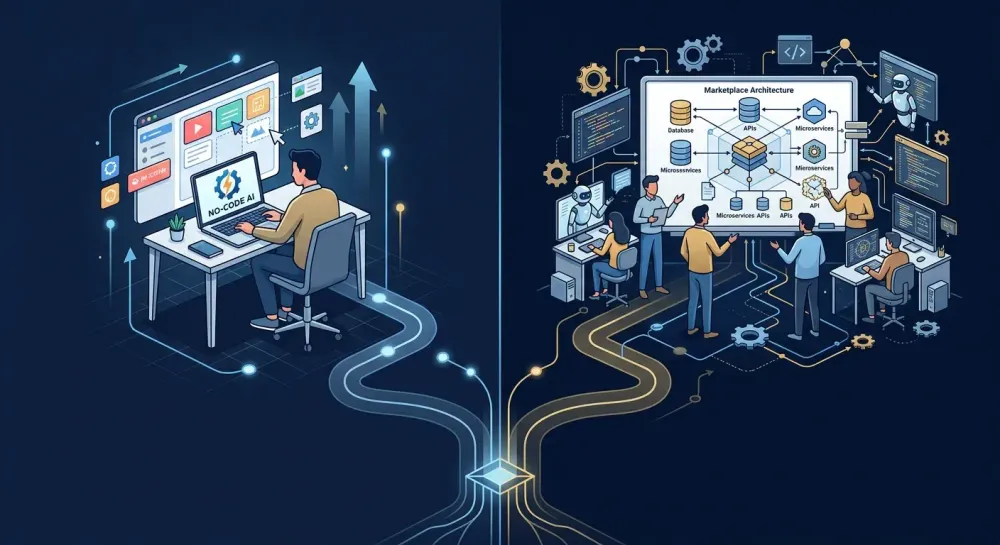
When a developer at icodelabs builds a marketplace using Claude Code or Cursor, the AI is executing within the developer's architectural vision. The developer knows what the foundation is. They know what can change and what cannot. When requirements shift — and they always shift — the developer directs the AI agents to implement changes that extend the existing architecture cleanly, rather than generating new code that conflicts with what came before.
The AI makes the developer faster. The developer makes sure the AI does not undermine the foundation.
The complexity ceiling problem
No-code AI platforms have a complexity ceiling. Standard flows — buy, sell, review — sit comfortably below it. But marketplace-specific requirements push against it quickly: custom multi-tier commission structures, multi-currency payouts across different markets, complex booking logic with deposits and cancellation penalties, integration with market-specific payment providers, shipping carrier API integration with per-seller logic, moderation systems, subscription-based seller access.
Each of these is achievable with professional development and AI tooling. Each of them becomes progressively harder to implement reliably on a no-code AI platform as the codebase grows, because there is no architectural owner ensuring that new complexity integrates cleanly with existing complexity.
The iteration cost problem
The promise of no-code AI platforms is speed. And in month one, that promise is delivered.
By month six, the inverse is often true. Iterating on a codebase that grew through prompts — without consistent architecture, without test coverage, without documentation — becomes progressively slower. Changes that should take hours take days. Debugging is difficult because the code is generated rather than authored — nobody truly understands why it works the way it does. Adding a feature requires understanding the full context of everything the AI previously generated, which gets harder as the product grows.
Professional development with AI tooling maintains speed over time because the foundation is solid. The developer understands the codebase because they designed it. AI agents accelerate new features because they operate within a clear, consistent architecture. Test coverage through Playwright catches regressions before they reach users. The codebase that ships in week six is built on the same foundation as the codebase that ships in week one.
How AI Changed Professional Development Too
While no-code AI platforms were changing what non-technical founders could build, something equally significant was happening inside professional development agencies.
AI coding agents — Claude Code, Cursor, Windsurf — fundamentally changed how experienced developers work.
The mechanical parts of software development: generating boilerplate, writing integration adapters, producing test coverage, navigating unfamiliar codebases, documenting systems — all of this became dramatically faster. A developer who previously spent three hours writing a Stripe integration adapter now directs an AI agent through it in forty minutes and spends the remaining time on review and edge cases.
Requirements analysis changed. Instead of a developer spending days producing a technical specification from a founder's brief, Claude produces a first-pass breakdown of user flows, data models, integration risks, and implementation approaches in hours — which the developer refines and owns.
Prototyping changed. Claude generates interactive visual artifacts of features — showing exactly how something will work before any code is written — replacing Figma wireframes for most early-stage design discussions.
Testing changed. Playwright test suites that previously took days to write are generated and iterated in hours through AI agents, meaning test coverage is no longer the first thing cut when a deadline tightens.
The result is that a professional development agency using AI tools properly delivers a Sharetribe marketplace in 6–8 weeks that previously took 12–14. The cost is lower. The quality is higher. The test coverage is better.
The gap between professional development and no-code AI platforms narrowed significantly — but from the professional end, not just from the no-code end.
How AI Is Reshaping the Startup Market
The combined effect of these two shifts — no-code AI platforms democratising prototyping and AI-augmented professional development compressing timelines and cost — is reshaping the startup market in ways that are still playing out.
The cost of being wrong dropped
Validating an idea used to cost $50,000 and six months. Now it costs $500 and a week. This is genuinely good for founders. The ability to test hypotheses quickly and cheaply before committing to full development means better-informed decisions and less wasted capital.
The barrier shifted from building to growing
The hardest part of building a startup used to be building it. Now the hardest part is growing it. More startups are launching than ever before. The ones that succeed are the ones that solve a real problem for a specific audience and find a sustainable way to acquire users — not the ones that built fastest.
The definition of MVP changed
A minimum viable product used to mean the smallest thing you could build. Now it means the smallest thing you can build that is also production-ready. Because users expect functional, reliable software from day one — even from a startup. A no-code AI prototype that breaks under real usage is not an MVP; it is a demo.
Technical debt arrived earlier
The speed of no-code AI development means technical debt accumulates faster than founders realise. A product that took two weeks to build on Lovable can take two months to properly rebuild on a maintainable foundation. Founders who treated their no-code prototype as a starting point rather than a throwaway are discovering this at the worst possible time — when they have users who depend on the product working.
How to Decide Which Approach Fits Your Stage
This is not a binary choice. The right answer depends on where you are and what you need.
Use no-code AI platforms if:
- You are testing whether an idea resonates before any real development investment
- You need a demo for investor conversations or early user interviews
- You are building an internal tool or lightweight application with simple data logic
- You have no budget for development yet and need to validate demand first
Use AI-augmented professional development if:
- You are building a marketplace with real payments between buyers and sellers
- You need Stripe Connect, escrow, split payments, or complex payout logic
- Your transaction flow has more than two steps or requires approval logic
- You are building for real users who will depend on the platform working reliably
- You need third-party integrations — shipping, calendar sync, CRM, identity verification
- You are raising investment and need a defensible technical foundation
- You tried a no-code platform and hit its limits The honest middle ground:
Many founders do both — they use Lovable or Bolt to validate a concept and get early user feedback, then come to an agency like icodelabs to build the production version properly. This is a legitimate strategy, with one important caveat: the no-code prototype is almost always thrown away rather than extended. Founders who expect to "hand over the Lovable codebase and continue from there" are usually disappointed. Budget for a fresh build, not a continuation.
Where icodelabs Sits
icodelabs is not in competition with Lovable or Bolt. They solve a different problem for a different stage.
What icodelabs offers is AI-augmented professional development — experienced developers using Claude Code, Cursor, Windsurf and Playwright as core tools, delivering production-grade marketplace builds faster and at lower cost than traditional development. Not prototypes. Not demos. Marketplaces that handle real payments, real users, and real transaction volume from day one.
For marketplace founders specifically — rental, service, product, booking — this is the gap that no-code AI platforms do not fill, and that traditional development agencies fill too slowly and at too high a cost.
The startup market is more competitive than it has ever been. Launching fast matters. So does launching right.
Final Thoughts
AI did not make building software easy. It made building prototypes easy and building production software faster.
That distinction matters for every founder making a decision about how to build their marketplace.
No-code AI platforms are genuinely useful tools at the right stage. They are not a replacement for professional development when real money, real users, and real complexity are involved.
The founders who navigate this correctly are the ones who understand which tool solves which problem — and make the transition from prototype to production before the limits of their no-code platform become the limits of their business.
If you are at that transition point, book a free scoping call with icodelabs. We will tell you honestly what makes sense for where you are.
FAQ
Can I build a marketplace with Lovable or Bolt?
Yes — and many founders have. No-code AI platforms can handle standard marketplace flows including Stripe Connect, basic escrow, and seller payouts. Where they struggle is when complexity accumulates: when business logic evolves, when features change, when requirements grow beyond what the original prompts anticipated. The platform has no architectural foundation to absorb that complexity cleanly, and the codebase becomes progressively harder to iterate on reliably.
What is the difference between no-code AI platforms and AI-augmented development?
No-code AI platforms like Lovable, Bolt, and Base44 use AI to generate an entire application from a prompt, without requiring a developer. AI-augmented development means experienced developers using AI agents — Claude Code, Cursor, Windsurf — to build faster and more accurately than traditional development. The output of AI-augmented development is production-grade, maintainable, scalable code. The output of no-code AI platforms is a functional prototype that may require significant rework to scale.
Is Lovable good for anything?
Yes — genuinely. Lovable is excellent for validating an idea visually, building a demo for investor conversations, and testing UI concepts quickly. It is a legitimate tool for the right use case. The problem is when founders use it for use cases it was not designed for — production marketplace infrastructure with real payments and real users.
At what point should a startup move from no-code AI to professional development?
When any of the following apply: you have paying users and real transaction volume, you need Stripe Connect with proper escrow and payouts, your business logic is more complex than the platform supports, you need integrations with third-party services, or you are raising investment and need a defensible technical foundation.
How is AI changing the cost of building a startup?
Dramatically. The cost of building an MVP has dropped by 60–70% in the last three years. No-code AI platforms allow non-technical founders to build prototypes for hundreds rather than thousands of dollars. AI-augmented development agencies like icodelabs can build production-grade marketplaces in weeks rather than months. The bottleneck has shifted from "can we build it" to "can we grow it."
Does icodelabs use the same AI tools as Lovable and Bolt?
No — different tools for different purposes. Lovable and Bolt use AI to generate entire applications from prompts. icodelabs developers use AI agents — Claude Code, Cursor, Windsurf — as a core part of their professional development workflow. The AI assists experienced developers; it does not replace them. The result is production-grade code with proper architecture, not AI-generated prototypes.
Can I start with Lovable and move to icodelabs later?
Yes, but the transition is rarely as smooth as founders expect. Most no-code AI platform codebases require significant rework rather than extension when moving to professional development. Starting with a properly architected foundation — even a smaller one — is usually faster and cheaper in the medium term than rebuilding from a no-code prototype.