In This Article
SHARE



Do You Have An Interesting Project?

Introduction
Most marketplace startups don’t fail because of bad ideas. They fail because they overbuild before they validate.
Founders spend months perfecting features, designing complex workflows, and investing heavily in custom development — only to discover that users behave differently than expected.
Building a Sharetribe Marketplace MVP is about speed with discipline. It means launching a functional marketplace that validates your core transaction model without overengineering features you may never need.
This guide explains how to approach a Sharetribe Marketplace MVP strategically, what to include, what to exclude, and how to launch significantly faster than traditional custom builds — without compromising long-term scalability.
What a Sharetribe Marketplace MVP Really Means
A Marketplace MVP is not a “cheap version” of your product.
It is a focused version.
It includes:
- A clear supply side (who lists)
- A clear demand side (who buys or books)
- A working transaction mechanism
- Payment processing
- Basic trust infrastructure
It excludes:
- Over-automation
- Advanced analytics
- AI recommendations
- Complex pricing engines
- Native mobile apps
- Multi-country expansion logic
Sharetribe provides the foundational marketplace infrastructure — user accounts, listings, transactions, reviews, and payments — so you can focus only on validating your marketplace’s core exchange.
When a Sharetribe MVP Is the Right Approach
A Sharetribe MVP works best when:
- You are testing a new marketplace concept
- You are entering a niche vertical
- You want to validate pricing and commission structures
- You need proof of traction before raising funding
- You want to reduce time-to-market risk
It is not ideal if:
- You already have high transaction volume
- You require highly specialized financial logic
- You are operating in heavily regulated financial environments
- Your model depends on deep custom automation from day one
How to Build a Sharetribe Marketplace MVP the Smart Way
Define the Core Transaction
Before touching configuration, answer:
- What exactly is being exchanged?
- Is it booking-based, product-based, service-based, or hybrid?
- When does payment occur?
- Is approval required?
- How are cancellations handled?
Transaction design is more important than UI design.
Configure Only What You Need
Sharetribe allows:
- Listing types
- Custom fields
- Search filters
- Commission settings
- Basic user roles
For MVP, configure only:
- One primary listing type
- Essential custom fields
- Basic filters
- One clear transaction flow
Complex listing hierarchies can wait.
Set Commission Structure Carefully
Your MVP must validate:
- Seller willingness to pay
- Buyer price sensitivity
- Platform margin viability
Even at MVP stage, commission logic should be deliberate. Avoid frequent structural changes after launch — they confuse early adopters.
Design for Trust, Not Perfection
Instead of pixel-perfect design, focus on:
- Clear onboarding instructions
- Transparent pricing
- Visible reviews
- Simple messaging
- Reliable checkout
Trust converts more than visual polish in early-stage marketplaces.
Seed Supply Before Launch
A marketplace with zero listings fails instantly.
Before public launch:
- Onboard 10–30 committed suppliers
- Personally assist early sellers
- Ensure listing quality
- Validate pricing expectations
Liquidity matters more than features.
Launch Soft, Then Expand
Release to a controlled audience first.
Observe:
- Where users drop off
- What questions they ask
- Where confusion occurs
- Whether transactions complete successfully
Your first 20 users teach more than your first 2,000 website visitors.
What Makes Sharetribe Ideal for MVPs
Sharetribe accelerates MVP development because it provides:
- Secure payment infrastructure
- Built-in review systems
- Messaging between users
- Transaction lifecycle management
- Role-based permissions
- Search and filtering
- Basic compliance-ready structure
You avoid building core marketplace mechanics from scratch.
That alone reduces development time significantly compared to fully custom builds.
Realistic Timeline Expectations
A structured Sharetribe MVP typically takes:
- 2–4 weeks for configuration-led builds
- 4–8 weeks if custom UI refinement is required
- 6–10 weeks if moderate custom logic is involved
The key is scope discipline.
Speed comes from clarity — not from rushing.
Common Mistakes in Marketplace MVP Builds
Overbuilding Before Validation
Adding advanced features before validating core demand increases burn rate and delays learning.
Treating MVP as Disposable
An MVP should evolve into your long-term product. Build with architectural foresight — not as a temporary experiment.
Ignoring Supply Strategy
Technology does not create liquidity. Founders do.
Your MVP should prioritize supply onboarding before marketing demand.
Underestimating Payment Testing
Test:
- Successful transactions
- Failed payments
- Refunds
- Disputes
- Seller payouts
Trust collapses quickly if payments break.
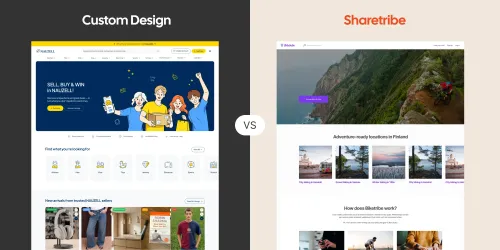
Sharetribe Configuration vs Custom Development
Today, Sharetribe allows two approaches:
- Configuration-driven marketplaces (minimal coding)
- Code-extended marketplaces (custom frontends, integrations, workflows)
For MVP, start configuration-first unless your model absolutely requires custom development.
Transition to code extension only when validated demand justifies it.
Key Takeaways
- MVP means validating the transaction, not minimizing effort.
- Focus on core exchange mechanics before feature expansion.
- Liquidity and trust matter more than advanced functionality.
- Sharetribe accelerates MVP development by solving infrastructure.
- Scope discipline determines launch speed.
- A well-built MVP can evolve into a scalable marketplace.
Conclusion
Building a Sharetribe Marketplace MVP is about reducing uncertainty — not reducing quality.
When done correctly, an MVP allows you to:
- Validate demand
- Test commission logic
- Refine onboarding
- Observe real user behavior
- Learn before scaling
The goal is not to launch the perfect marketplace.
The goal is to launch the smallest version that proves your marketplace deserves to exist.
Speed matters. But clarity matters more.
Build the right foundation — then scale with confidence.
Related Blogs