In This Article
SHARE



Do You Have An Interesting Project?
Sharetribe Customization Services: What Founders Should Know Before Building
Introduction
Many marketplace founders assume that building a platform like Airbnb or Etsy requires a fully custom backend from scratch.
That assumption is no longer true.
Sharetribe provides a managed marketplace infrastructure that handles core backend logic — listings, users, payments, messaging, and transactions — while allowing full customization of the frontend and business logic through APIs.
The real question is not whether you can customize Sharetribe.
The real question is how far you should customize it — and where the architectural boundaries are.
This guide explains:
- What Sharetribe customization actually means today
- What can be modified and extended
- How transaction processes work
- How payment architecture decisions affect your build
- Where founders often miscalculate scope and budget
This article is written specifically for founders evaluating Sharetribe for serious, production-grade marketplaces.
What Sharetribe Customization Really Means
Sharetribe is a marketplace infrastructure platform with:
- No-code configuration through the Sharetribe Console
- API-first extensibility
- A React-based Web Template (Next.js) for full frontend control
Customization happens at three primary levels:
Configuration Layer
Through the Console you can define:
- Listing types
- Custom listing fields
- Availability rules
- Commission structure
- Transaction processes
- Email notifications
- User roles
- Stripe Connect configuration
Many marketplace models can be configured without touching code.
Frontend Layer
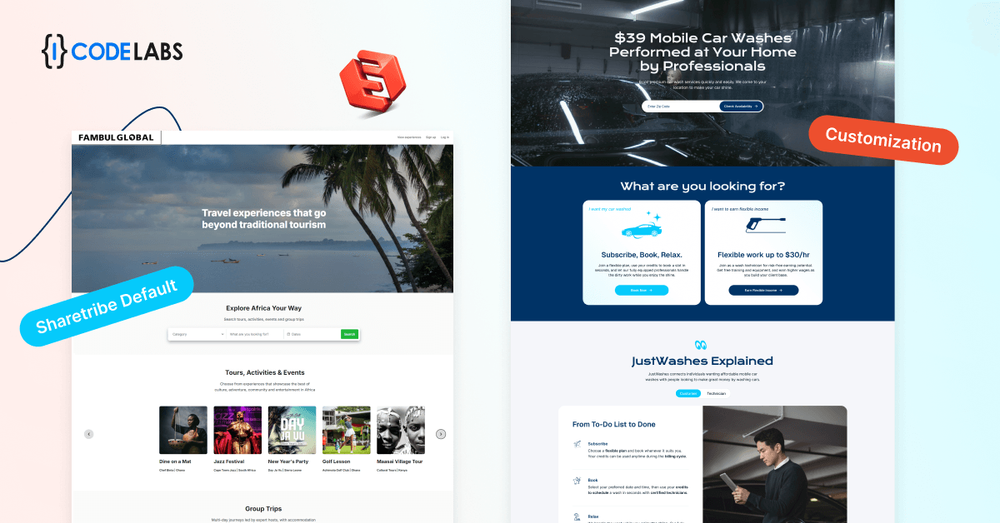
The Sharetribe Web Template controls:
- Homepage layout
- Search interface
- Listing pages
- Checkout experience
- User dashboards
- SEO structure
- Custom landing pages
You have complete control over UI and UX.
The backend remains managed by Sharetribe.
Integration and Automation Layer
Using the Marketplace API and Integration API, you can build:
- Subscription-based marketplaces
- Tiered seller permissions
- Custom onboarding flows
- KYC integrations
- Calendar sync
- Shipping integrations
- CRM and analytics automation
- AI-powered features
- Custom payment orchestration
This is where marketplaces move beyond MVP into scalable products.
How Sharetribe Customization Works in Practice
Define the Marketplace Model First
Before development begins, clarify:
- Commission-based or subscription-based revenue
- Instant booking or request-to-book
- Deposit requirements
- Multi-role permissions
- B2B or B2C positioning
- Tax and compliance needs
Customization should follow business logic, not aesthetics.
Configure the Transaction Process
The transaction process defines how buyers and sellers interact.
This includes:
- Inquiry flow
- Booking approval
- Payment timing
- Payout release
- Cancellation conditions
- Review sequence
It is defined using a process configuration and deployed via Sharetribe’s CLI.
Changing this later in production is possible but complex. Planning early reduces risk.
Customize the Frontend Experience
The React-based Web Template allows:
- Full branding control
- Custom UX flows
- Marketplace-specific layouts
- Advanced filtering interfaces
- Conversion-focused landing pages
This is where differentiation happens.
Extend Through APIs
Advanced features typically require:
- Integration API services
- Background workers
- Webhook listeners
- Custom microservices
Examples include:
- Subscription tier enforcement
- Automatic suspension on expired plans
- Dynamic pricing logic
- Event-driven notifications
- External payment integrations
Payment Architecture in Sharetribe
Sharetribe’s native transaction engine is tightly integrated with Stripe Connect.
Within the default setup, Stripe handles:
- Escrow
- Split payments
- Commission distribution
- Payout scheduling
- Refund handling
- Compliance workflows
You cannot simply replace Stripe inside the native transaction flow.
However, alternative payment providers can be implemented using the Integration API and a custom payment orchestration layer.
This requires:
- Managing payment flows externally
- Handling escrow logic in your own backend
- Managing payouts and refunds manually
- Taking on additional compliance responsibility
This approach increases flexibility but also increases technical complexity and operational burden.
For most marketplaces, Stripe Connect remains the most scalable and compliance-ready solution.
The key is understanding the architectural tradeoff before committing.
What You Can Customize
- Full frontend UI and UX
- Listing structures and extended data
- Commission models
- Transaction processes
- Search configuration
- User roles
- Email templates
- Third-party integrations
- Subscription logic
- Automation workflows
- Custom payment orchestration
Platform Constraints to Understand
- The backend infrastructure is managed and not directly accessible
- The database cannot be modified directly
- Transaction flows must follow the defined process structure
- Replacing native payment logic increases backend responsibility
Knowing these constraints avoids unrealistic expectations.
Common Founder Mistakes
Starting frontend design before defining transaction logic
The transaction process is the backbone. Design should follow logic.
Over-customizing before validating traction
Build lean. Add complexity after proof of demand.
Underestimating payment architecture decisions
Escrow, VAT, split payments, refunds — these must be mapped early.
Assuming Sharetribe is a generic CMS
It is a marketplace engine with opinionated architecture.
Underestimating mobile effort
There is no official mobile template. A mobile app is a separate development initiative built on top of the APIs.
When Sharetribe Is the Right Choice
Sharetribe is ideal when:
- You want to launch in weeks, not months
- Your model fits marketplace interaction patterns
- You want managed backend infrastructure
- You prefer proven payment flows
- You want API extensibility without building core systems
When a Fully Custom Build May Be Better
You may consider a custom backend if:
- You need complete control over payment infrastructure
- You require non-standard transaction logic
- You need deep backend modification
- Your business model diverges significantly from marketplace norms
Making this decision early prevents costly migrations.
Benefits of Sharetribe Customization Services
- Faster time to market
- Lower backend engineering effort
- Managed infrastructure
- Scalable transaction engine
- API extensibility
- Clear separation between frontend and backend
For founders with development support, this creates a strong balance between speed and flexibility.
Conclusion
Sharetribe customization services allow founders to start with a proven marketplace infrastructure and shape it into a differentiated product.
The platform removes the need to build authentication, listings, payments, and transaction management from scratch. At the same time, it allows full control over user experience and advanced integrations.
The critical factor is not whether customization is possible.
It is whether your customization decisions align with your long-term architecture and business model.
Founders who plan transaction logic, payment strategy, and integration requirements early avoid expensive rebuilds later.
Frequently Asked Questions
What can be customized in Sharetribe?
The frontend, listing structure, transaction processes, commissions, integrations, and automation workflows can all be customized. The backend infrastructure is managed and cannot be directly modified.
Do I need developers for Sharetribe customization?
Basic configuration can be handled in the Console. Advanced customization requires React and API development expertise.
Can I use payment providers other than Stripe?
Yes, but not inside the native transaction engine. Alternative providers require a custom payment architecture using the Integration API.
Can I build a mobile app?
Yes. Sharetribe is API-first. A mobile app can be built using React Native or other frameworks, but it requires separate development effort.
Is Sharetribe scalable?
Yes. The backend infrastructure scales automatically. The frontend architecture and integrations must also be built correctly to handle growth.